UAS Operator Registration
The UAS operator (you, or your employer) is usually registered once with the IAA — not once per drone.
The remote pilot is whoever is actually flying that day; they can be the same person, or not.
The Interactive Guide
My Flight Pathway
Three separate things usually need checking before your flight. Use the interactive guide above to work out which category of operation you might need to fly in, then come back to My Flight Pathway to go through the actual requirements in more detail.
The UAS operator (you, or your employer) is usually registered once with the IAA — not once per drone.
The remote pilot is whoever is actually flying that day; they can be the same person, or not.
Remote pilots need to be competent. Depending on the drone being used and the operation being conducted, a remote pilot will need one or more of:
Each certificate requires passing an exam, and each certificate is valid for 5 years.
EU drone rules focus on the risk of the operation, not on why it’s being conducted.
As such, regulations don’t focus on whether you’re flying commercially or recreationally. What matters is the ground risk and the air risk of your operation.
EU drone operations are split between two main categories: the Open category, for low ground and air risk operations, and the Specific category, for when you can’t do what you want to do under the Open category rules.
The regulations identify two specific entities: the UAS Operator and the Remote Pilot.
Defining these as two separate roles doesn’t mean one person can’t wear both hats — the UAS Operator hat and the Remote Pilot hat. This is often the case for recreational pilots and sole traders, who take on both sets of responsibilities and ensure compliance with the regulations in both regards.
In larger organisations, such as limited companies or government organisations, the legally defined company often acts as the UAS Operator, with a person identified as the Accountable Manager responsible for overseeing the UAS Operator’s responsibilities. The organisation may then have one or many Remote Pilots, who take on the role of flying the drone on its behalf and managing the Remote Pilot’s responsibilities when doing so.
A UAS Operator is required to register if any of these apply:
UAS Operators register with the EU member state competent authority (in Ireland, this is the Irish Aviation Authority, the IAA).
If you are already correctly registered as a UAS Operator in another EASA member state, you should not register again in another EU member state. Use your existing UAS Operator registration.
Irish-based individuals and organisations register through the IAA’s MySRS system. Visit the IAA drones hub to register.
There is a fee for operator registration, paid to the IAA — see the IAA schedule of charges. New to MySRS? There’s a step-by-step guide to creating an account.
Remote pilot training is intended to ensure that pilots understand the regulations governing UAS operations, the aircraft and equipment they operate, and the environment in which flights take place.
The Remote Pilot is responsible for the safe and lawful conduct of each flight. They must possess sufficient knowledge, practical competence and judgement to determine whether an operation can safely and legally commence, continue or must be discontinued if conditions deteriorate.
The level of training and qualification required increases with the complexity and risk of the intended operation.
Note 1: Remote Pilot certificates are issued after successfully completing the relevant exam. Exams are hosted by the Irish Aviation Authority (IAA) on their MySRS system. There is a fee for the certificate, payable to the IAA, and each certificate is valid for 5 years.
Note 2: The A2 certificate qualifies the Remote Pilot, not the drone. Only a genuine C2-labelled drone can be flown under A2.
Note 3: A paid training course is never a legal substitute for the official IAA-recognised exam or certificate. A training course prepares you to pass the exam.
Note 4: If your preferred operation falls outside what is permitted by Open category regulations, you move into the Specific category. Additional Remote Pilot training competency is required, and the UAS operator requires an operating permission, known as an Operational Authorisation, to operate the drone. Talk to Safe Drone Academy.
Operating in the Open category is where most organisations and remote pilots start. It has three subcategories — A1, A2 and A3 — each carrying slightly different rules for what is, and isn’t, permitted.
See your results from the interactive guide above for guidance on which subcategory best suits your operation.
If your intended operation isn’t possible within what’s permitted under the Open category, you’ll need to move from the low-risk Open category into the more advanced, medium-to-high-risk Specific category.
| A1 — Close To People | A2 — Near People | A3 — Far From People | |
|---|---|---|---|
| Typical Drones | C0, C1, eligible under-250 g legacy/privately built | C2 only | C2, C3, C4, eligible legacy 250 g–25 kg |
| Distance From Uninvolved People | May fly in Residential, Commercial, Industrial & Recreational Areas May fly over individuals (C0); C1 should avoid it — never over assemblies |
May fly in Residential, Commercial, Industrial & Recreational Areas Remain 30 m horizontally from uninvolved persons, or 5 m if a genuine low-speed mode is activated |
Operating area always 150 m from residential, commercial, industrial and recreational areas Recommended to remain at least 30 m horizontally from uninvolved persons located in your operating area |
| Geographical (Airspace) Zones | Around major airports: prohibited from RED zones entirely, and from AMBER zones above 30 m AGL (Applicable to Ireland) | ||
| Pilot Certificate | Valid A1/A3 Certificate | Valid A1/A3 and valid A2 Certificate | Valid A1/A3 Certificate |
| Assemblies Of People | Never permitted, in any subcategory | ||
C0 and eligible under-250 g legacy/privately built drones may fly over individual uninvolved people, but never over an assembly of people.
C1 drones should avoid flying directly over uninvolved people where possible. If it happens briefly and unintentionally, minimise the time spent over them. Never fly over assemblies of people, in any case.
Only C2-labelled drones.
Only pilots with an Open A2 certificate.
Keep at least 30 m horizontally from uninvolved people.
Keep 5 m from uninvolved people when the drone’s low-speed mode (typically around 3 m/s) is active.
A commonly used planning guide is to keep horizontal distance at least equal to height (a “1:1” ratio) — useful guidance, but the C2 drone class, the Open A2 certificate, and the 30 m (or 5 m low-speed) distance rule are what actually governs.
No overflight of uninvolved people.
C2, C3, C4, and eligible legacy 250 g–25 kg drones.
The operating area should always be at least 150 m horizontally from residential, commercial, industrial, and recreational areas.
Within the operating area, if any uninvolved person enters it, the recommendation is to keep the drone at least 30 m horizontally from them — or apply the “1:1” ratio (horizontal distance at least equal to height).
Visual Line Of Sight Operation
Maximum Operating Height
Dropping Material
Carrying Dangerous Goods
Visual line of sight (VLOS) means the remote pilot must always be able to see the drone unaided. You can wear glasses or contact lenses, but you cannot use camera feeds, binoculars or telescopes to maintain visual line of sight with the drone — these devices narrow the field of view around the drone, limiting the remote pilot’s ability to scan the surrounding airspace and spot other aircraft in time to avoid a collision.
If the remote pilot is focused on a screen or flying with first-person-view (FPV) goggles, they may be assisted by an unmanned aircraft observer. Anything beyond what’s allowed here is not visual line of sight (VLOS). It becomes beyond visual line of sight (BVLOS), which is a Specific category operation.
The Open category caters for low ground and air risk operations, and is built around a fixed set of rules defining exactly what can and cannot be done. These rules won’t suit every organisation’s or remote pilot’s operational needs. Where an operation can’t be conducted safely and legally within the Open category, it moves into the Specific category.
The Specific category permits medium- to high-risk operations: those that fall outside what the Open category allows. Typical reasons for operating in the Specific category include needing to:
Not every drone carries a C0–C4 class label. A CE mark on its own is not a class label — almost all electronics carry one. Check the drone itself and the manufacturer’s EU declaration of conformity; different versions of the same model can carry different class labels.
If placed on the market (or sold) before 1 January 2024, these drones can still be flown under the Open category.
A drone you build yourself, for your own use (not a ready-to-assemble kit sold as a finished product), can be treated like a C0 or legacy drone under 250 g. Check your build’s actual limits, since this is a technical condition worth confirming precisely rather than assuming.
If a person is under 16, they must be supervised by a remote pilot aged 16 or older. The minimum age for a remote pilot in Ireland is generally 16, under the framework set by Regulation (EU) 2019/947.
Insurance is governed by EU aircraft insurance requirements. If you’re flying for sport or recreational purposes and your drone weighs less than 20 kg, no third-party public liability insurance is required.
In all other cases, a minimum of third-party public liability insurance is required.
Permitted in the Open category. Your drone must show a green flashing light so it can be identified as a UAS in flight, and you still need to maintain visual line of sight in the dark.
C1–C3 class drones in the Open category must, by law, carry direct remote identification — a system where the drone broadcasts its position and the UAS operator’s registration number.
These drones must also have a geo-awareness function. The UAS operator downloads the latest geographical zone file from the competent authority’s website (the IAA, in Ireland) and loads it into the drone, so it can alert the remote pilot when they may be operating in a geographical zone.
Be conscious of flying over residential areas, and avoid disturbing people in their private residences.
If you’re using a camera or other means to capture personal data, GDPR may apply if you’re doing anything other than recreational flying.
Always complete a basic pre-flight check of the airframe, props and battery, and fly within the manufacturer’s wind, temperature and precipitation limits.
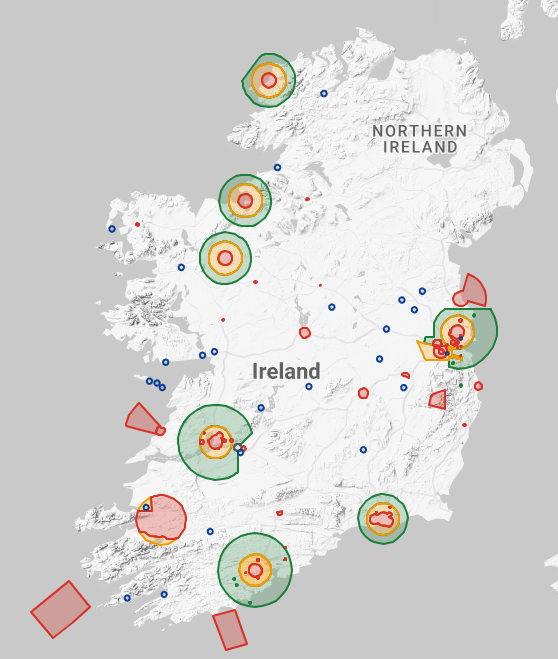
A pilot qualification and a legally compliant drone do not grant unrestricted access to the sky. Every flight needs a current check of the geographical zone you’ll be flying in — restrictions can be permanent (e.g. near airports) or temporary (e.g. events, emergencies). A zone colour alone is not sufficient information to decide whether you can fly — follow the specific published conditions for that zone. Landowner permission to take off or land is separate from these aviation requirements; you need both.
Safe Drone Academy Geozone Map Official IAA Geographical Zones
If your flight looks like it needs the Specific category, or you’re unsure about any result above, Safe Drone Academy can help you work out exactly what’s needed.
Discuss My Flight With Safe Drone Academy